
Alma
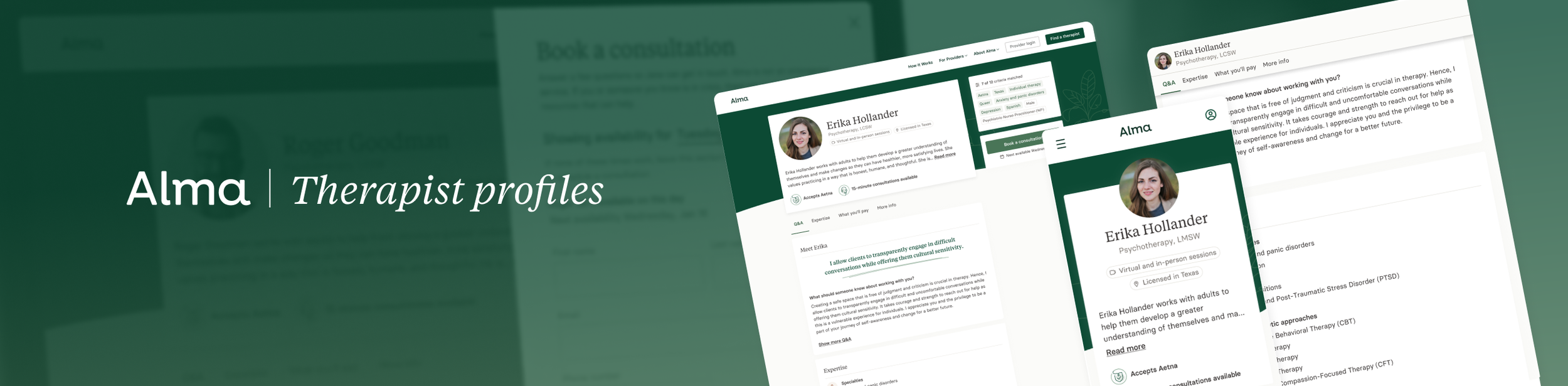
Therapist Profiles
A scalable landing page for mental health providers to promote themselves and for clients seeking care.
SCOPE
Product design
Visual design
Info architecture
UX research
business impact
Transformed Alma's therapist profiles to improve consultation conversion, tripling profile edits, and saving up to $300k/year in manual review costs.
July – September 2023
Phase 1 — Redesigning the public profile
PROBLEM DEFINITION
Public profiles represent the first time clients “meet” with providers, yet today’s profiles aren’t optimized for either user.
Providers want to grow their case loads
Profiles only represented a photo, some filters, and outdated content. They’re often inaccurate, incomplete, or considered low quality, thus resulting in fewer referrals.
Clients want to match with a provider
Profiles don’t tell them whether a provider might be a good match. They relied heavily on the photo to gauge vibe and personality.
Hover to SCROLL ↓
v0: Control
DESIGN CHALLENGE
How might we design a public profile for clients to gauge prospective therapists, and for therapists to market themselves and their growing practices?
HYPOTHESIS SOLUTIONs
If we highlight the Q&A higher on the profile, then clients will get important information and therapist’s personality more quickly.
If we reduce UX friction on the profiles, clients will be able to digest information and take action quickly.
If we modularize the profile page, then we’ll be able to adapt content and create space for future opportunities easily.
RESEARCH VALIDATION
Participatory research that goes beyond asking and observing
With provider profiles being one of the most visible and trafficked surfaces on our site, I knew that any changes to information hierarchy needed to be grounded in real user input — not assumptions.
Rather than running traditional usability tests, I facilitated co-design sessions with 10+ providers and clients, putting design tools directly in their hands to surface what they actually needed from a profile, not just what they could articulate in an interview.
After co-designing 10+ profiles and interviewing users to understand what content resonates with them, we learned that:
Providers wanted to make sure clients understood who they were “at a glance,” including their specialties, modalities, payment options, and populations served.
Conveying their “personalities” was the most challenging part of updating their profiles.
Clients typically already have some search criteria in mind. They weighed the biography, interview questions, and photo to gauge a provider’s “vibe”.
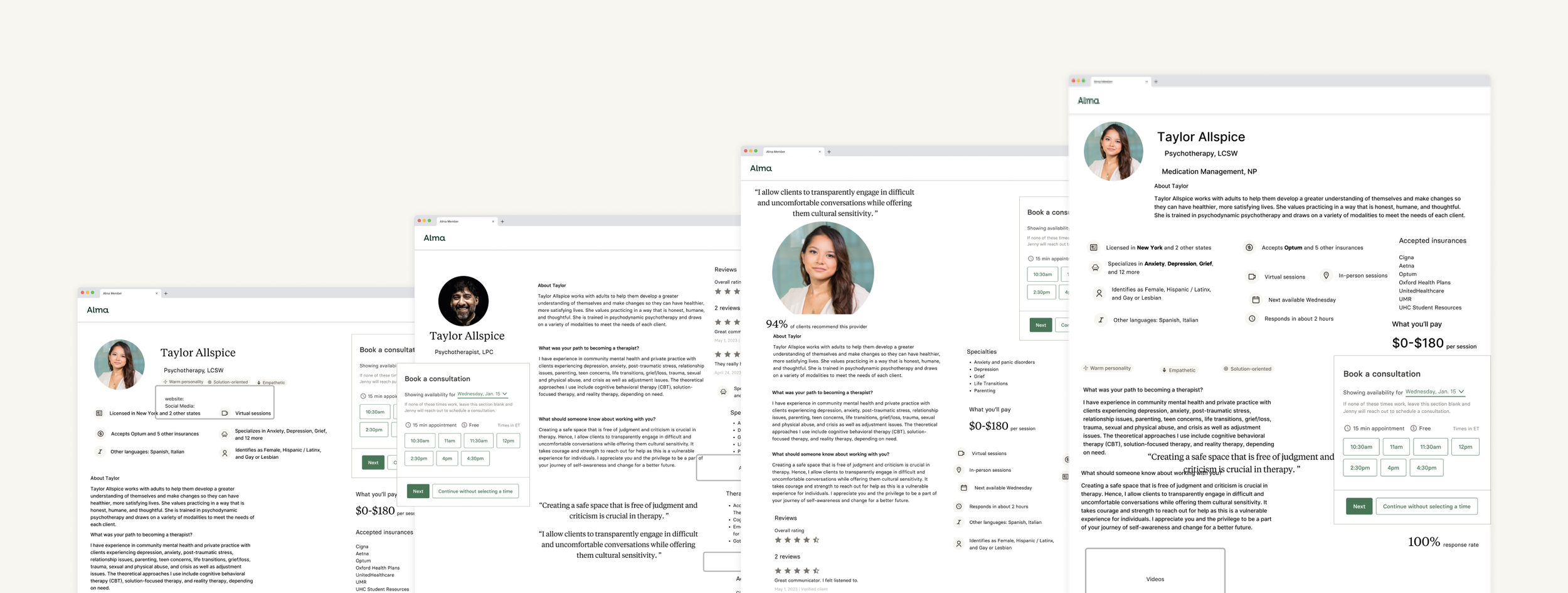
“I feel like it’s looking for my personal needs. I know it’s just a website, but I feel like it’s listening to me more.”
With two users, competing needs, and no prior design foundation to build from, I developed six principles to align the team around what "good" looked like before any design work began.
DESIGN Principles
When we think of a high quality therapist profile, they are…
Recognizable
It’s digestible, scannable, and requires little effort to understand.
Relevant
It’s easy to spot attributes about providers that’s most relevant to clients.
Accurate
The offerings, competencies and availabilities of providers are up-to-date and accurately reflects their skillsets.
Action oriented
Clients can take action and feel confident in next steps they can take with the provider.
Easy to navigate
It’s easy to navigate to different sections and other profiles.
Mobile-friendly
The public profile experience is optimized for mobile users given that the majority of our traffic comes from mobile.
v1: Mobile profile design
The results
A +2% relative improvement in search → conversion
We A/B tested the new design against the previous profile, measuring search-to-consultation conversion as the primary metric.
Because this redesign touched UX, information architecture, and visual design simultaneously, we weren't optimizing a single variable — we were building a new foundation. With that scope in mind, a 2% relative improvement in search-to-consultation conversion was a strong signal that the new experience resonated, and gave us the confidence to roll out to 100% of users and begin layering more targeted experiments on top.
December 2023 – February 2024
Phase 2 — Giving providers ownership
Three months after Phase 1 shipped in September 2023, a new problem emerged that the redesign had quietly made possible to solve.
Problem theme
The process of updating profile content required therapists to fill out a request form that was processed by the Ops team at Alma’s.
Ops manually reviewed and edited every update, which cost 200 hours of manual hours per month and upward toward $300,000 per year. Manual reviews also caused major inconsistencies in content and quality across profiles in the Alma directory.
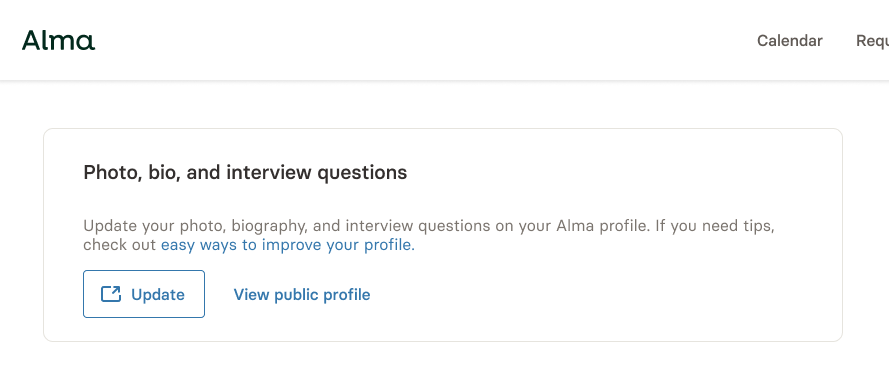
v0: Uneditable profiles
Design Solution
Giving providers more autonomy over their profiles meant allowing them to edit their own photos, biographies, and interview questions.
In addition to a massive amount of re-architecting, I worked with Ops, Brand, and our content designer to establish new, consistent content guidelines and quality standards in order to eliminate manual reviews. We built in-line editing into the portal, standardized interview questions, and provided error handling and education to maintain high-quality profiles.
v1: Editable profiles
The result
We empowered providers to take ownership of their marketing their practices without needing the Alma support team.
This resulted in:
3x increase (362%) in profile edits
16% increase in photo edits
Decrease in Ops time spent from 2.5 hr/week to 1 hr/week
Next Steps
Going forward, I'd continue identifying new content types and conversion hypotheses to make profiles richer and more useful — testing things like provider-uploaded videos, dynamic display of filters that match a client's search criteria, or other personalization signals that help clients feel confident they've found the right fit.
What I learned
This project was ultimately about trust — trusting that providers, given the right tools and guardrails, would take ownership of representing themselves well. By applying systems thinking to solve for both clients and providers simultaneously, we were able to shift the onus of profile quality from the business to the people who had the most to gain from it.
The results validated that bet. Giving providers control over their own content didn't just reduce operational burden — it created a more accurate, higher-quality directory that served clients better in the process. It also relieved pressure from the business: when providers have direct ownership of their profiles, the responsibility for attracting consultations sits with them, not with Alma's ops team.